
We look forward to learning with the following artists in 2026. Click on images to find out more about them. |
 September 2026 |
I'm a Canadian research artist interested in paradigm shifts in culture related to ecology. I have a love for biology and natural philosophy and I raise giant silk moths. I'm a long time amateur mycologist and travel the world in search of wild mushrooms, witches’ markets, muppety birds, wild things to ferment and gates to open along wildlife corridors. My work, which often highlights the kinship of Art, Science and magic is really just an invitation for you to indulge in your geekiest interests. |
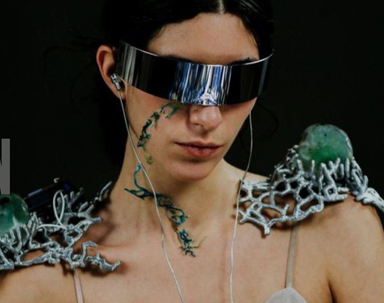
Catherine Euale is a textile artist, social justice and environmental activist, costume designer and storyteller. In her practice, she challenges the need to use materials and methods that are noncompatible with living systems. She believes deepening and shifting our relationships with the material can raise awareness of our forgotten relationships within more than human worlds, planting seeds for a “good Anthropocene”. Designing systems for interspecies worlds can ignite tremendous political, social, and philosophical implications that we must consider for a resilient and harmonious future. |
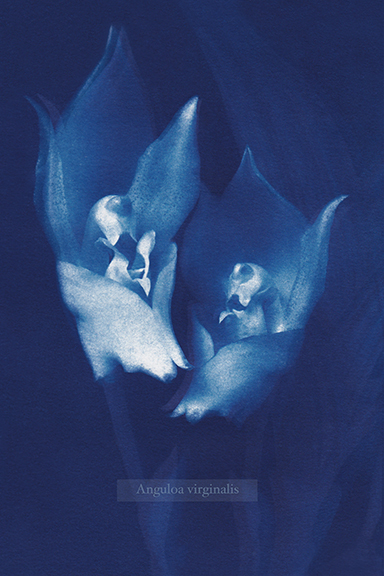
I am a Bolivian-Canadian visual artist whose practice integrates nature exploration, botanical research, and the creation of deep connections between people and the natural world.
|
I am interested in what we consider holy and how we signal that it is. Starting in 2023 with the exhibition Membranes, I have worked intensely with the biological and mathematical building blocks of life, my theory being that these are what we will consider holy in future religious practices, when the patriarchal, Abrahamitic religions have been supplanted.
|
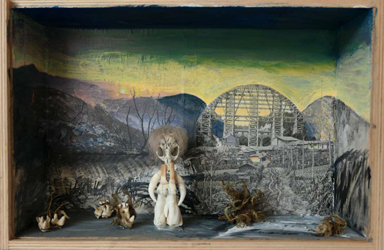
“Renée Magañas oeuvre resembles a virtual cemetery. But a cemetery that one visits with pleasure. Death and transience are indeed woven into all her art. Her work is colorful and cheerful, combining the child's casual curiosity with the adult's experience of loss, sensitive remembrance with subtle cheerfulness.” As a half-Mexican living in Switzerland for several decades, my artistic work deals with the different ideas and significances of death in different cultures. In Mexico, death is not a taboo, but often the subject of an ironic debate that is reflected in the light-hearted representation and form of skeletons, among other things. Death has a high value in various Mexican traditions. My artistic practice does not distinguish between my daily life and my artistic interests. I am inspired by memories, triggered by different incidents: a smell, a photograph, an environment, a sound, the light, a film. I have been collecting, researching and preserving things dead or relating to death – as an artist and as a private person – for several decades. I collect the overlooked, the left behind, the lost or forgotten. It is a fascination for discovery in the old and the used and how I can transform them in order to present hidden stories they might have to tell. |
My practice is rooted in illustrative documentation, material exploration, and curiosity-driven ways of learning from land, plants, and people. As an illustrator and eco-arts practitioner, I explore the intersections of storytelling, place-based research, and experimental craft through drawing, printmaking, and natural materials. |
Gideon Hermann is a jeweler and metalsmith currently located in northwestern Pennsylvania. They are pursuing a Master of Fine Arts degree at Pennsylvania Western University, Edinboro. They received their Bachelor of Fine Arts with a focus in Jewelry and Metalsmithing and a Digital Fabrication and Design Certificate at the University of Wisconsin-Milwaukee in May 2021. Their work examines post-industrial landscapes, particularly those of the Rust Belt, and the evolving relationship between industry, ecology, and time. They are drawn to places where natural processes reclaim abandoned structures: rust and rot creep in, plants emerge through concrete, and buildings slowly collapse back into the environments they once dominated. Rust is central to this work, acting as both a material and metaphor for decay, memory, and nature’s persistent reclamation. Gideon works with mild steel, using rust as a collaborator rather than fighting against it. In their series of “Temporary” brooches, they expose steel to the elements and periodically paint them, mirroring the futile attempt to halt rust on urban infrastructure using paint. The steel continues to corrode beneath each layer, causing the paint to crack and flake. Over time, these layers form an archive of the struggle between preservation and inevitable decay. In this series, Gideon periodically documents the work to create a photographic archive of each brooch’s decay over time. Ecology is another conceptual anchor for their work. To them, post-industrial sites hold both harm and hope. These sites bear the scars of extraction, yet plants emerge that remediate soil, water, and atmosphere. Gideon explores plants as agents of healing and interdependence, enabling us to imagine futures where human and non-human beings thrive together. Jewelry, as a format, allows these ideas to unfold at the scale of the body. Its intimacy encourages the viewer to look closely. By miniaturizing industrial forms and elevating overlooked organisms, they create opportunities for slow observation and renewed connection. This work sits at the intersection of geometry and chance, industry and ecology, decay and regeneration. Through metalsmithing, they aim to cultivate empathy, attention, and a deeper understanding of the living systems that persist within and beyond post-industrial landscapes. |
|
Alumni
We have had the absolute pleasure of learning with hundreds of amazing artists over the years. You can find them here. Click on a topic to see all of the Biophilium and Ayatana artists who have been research fellows and artists in residence with us since 2014.
|
|